Stamped concrete in Springfield gets judged from the sidewalk, usually by a neighbor holding a coffee, and a bad one gets spotted before the truck is off the street. The tells never change: the same stone repeating like bad wallpaper, a release agent hosed off in a hurry so the color goes flat and chalky, and edges that wander like they were laid out by feel.
I run The Springfield Concrete Company, and we pour stamped patios, walkways, pool decks and stamped walls from Forest Park and Sixteen Acres out to East Longmeadow, Agawam and Chicopee.
Here's what we won't do to you. Say eight and show up at noon. Send you to voicemail for three days. Talk over your head about slump and air entrainment instead of answering the question you asked. Leave broken forms and washout in the side yard for you to deal with.
Below I walk through how the pour actually goes, the patterns and colors worth choosing, what moves the number on your estimate, and the things people ask me before they book. Read it, then call (417) 464-6822 and I'll come stand in the yard with you.
Textured Concrete
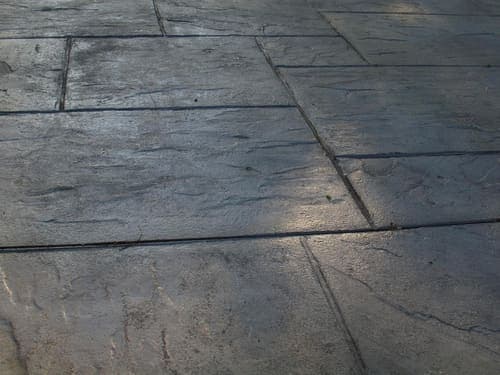
Textured concrete gives you the grain and grit of stone without grout joints, and we press it in with seamless skins so a wide patio doesn't read like a tile floor. The whole thing lives inside a window. Push the skins in too early and they sink and drag slurry across the surface; wait too long, and on a hot July afternoon that's maybe ninety minutes, and you get a faint scuff instead of real texture. There's no second take. At The Springfield Concrete Company we set enough hands on the slab to skin the full pour before it goes off, and we run the same skins up step risers and stamped walls so the vertical faces match the flatwork. Texture also buys you grip, which matters on a shaded walk that stays wet under the maples until noon.
Exposed Aggregate Concrete
Exposed aggregate concrete is the one where the stone does the talking, and it's my favorite pour on a hot day. We either seed pea stone and river rock into the fresh slab or expose what's already in the mix, spray a surface retarder over the top, then come back the next morning to wash and brush the cream off. Timing is the whole game. Go too early and you pull stones right out; wait too long in an August pour and you're fighting it with acid and a stiff broom.
Done right, you get a gritty, non-slip surface that handles a Springfield February better than most textured concrete, though a plow blade and rock salt will still find the weak spots, so we reseal every two or three years.
Half the aggregate walks we run at The Springfield Concrete Company get a stamped border for contrast.
Stamped Concrete Driveway
A stamped concrete driveway takes more punishment than anything else you own, so we pour it thicker: five to six inches over a compacted gravel base, fiber in the mix, rebar where the truck sits. Skip that base and you get the same story every March, when the frost lets go and a hairline crack becomes a real one by the Fourth of July. We cut control joints along the pattern lines, so if the slab moves it cracks where we told it to.
Figure about a week of us in your driveway, then seven to ten days before you park on it. Resealing every two or three years, because plow blades and road salt don't care how good it looks.
Have us at The Springfield Concrete Company pour the apron and the stamped concrete curbing in the same trip and your edges stop chipping.
Ashlar Slate Concrete Stamp
The ashlar slate concrete stamp is the pattern I lay more than any other from Sixteen Acres out to East Longmeadow, and there's a reason for it. The stones are random rectangles, so a joint that runs a hair off still reads as stone instead of a mistake. The mats come as a set of five or six, and they have to go down in sequence and get rotated. Skip that and the same "stone" shows up every eight feet, which your eye catches from the porch like a scratch on a record.
We stamp when the slab holds a boot print about a quarter inch deep, then chisel the joints by hand at the perimeter and tight to the house where no mat fits. That hand work is the slow half of an ashlar job at The Springfield Concrete Company.
Stamped Concrete Colors
Stamped concrete colors come from two places on our pours: integral color mixed into the truck, and a dry-shake hardener we broadcast and float into the fresh surface. The hardener builds a denser, harder top with more depth of tone. Integral color runs all the way through, so a chipped edge in February doesn't flash pale gray at you. On most jobs we use both.
Where it goes sideways is between loads. One truck colored, the next one ordered wrong or tempered with a hose on site, and now your slab has two moods across a control joint. Nobody unsees that.
At The Springfield Concrete Company we cast sample squares and let you look at them wet, dry and in your own yard's afternoon light. Some folks pick stamped concrete no color at all, just texture. That's a real choice too.
Stamped Concrete Patterns And Colors
Stamped concrete patterns and colors get chosen in about ten minutes and then you look at them for the next twenty years, so I make people slow down. Scale matters more than style. A big random flagstone swallows a 10 by 12 patio, while running bond brick or a wood plank texture reads better on a small pour, especially with a soldier course border framing it. Color happens twice: an integral base mixed in the truck, then antiquing worked into the joints so the slab doesn't sit there like one flat sheet of gray stamped concrete. We keep sample boards at The Springfield Concrete Company shop, and I want you carrying one outside into real daylight, because everything looks different under a garage bulb. Textured concrete and stamped walls can repeat the same pattern to tie a yard together.
Stained Stamped Concrete
Stained stamped concrete is what I'd steer you toward when the slab is already down and the color has gone tired, or when you want more depth than one flat tone can give. Acid stain reacts with the lime in the slab, so it never lands perfectly even, and that's the whole charm of it. It mottles like real bluestone. Water-based stains hand you more control if you're matching trim or a pool coping.
The steps that matter: strip the old sealer, scrub it, neutralize the acid, rinse until the water runs clear, then two coats of sealer. Skip the neutralizing and you'll get haze and peeling by the second Springfield winter.
At The Springfield Concrete Company we won't stain a fresh pour until it's cured a solid 28 days. Rushing that shows up in the color forever.
Stamped Concrete Release Agent
A stamped concrete release agent is the powder or liquid we dust across the slab right before the mats go down, and it does two jobs at once: keeps the rubber from sticking and drops a second tone of color into every crevice of the texture. That antiquing is why a stamped patio reads like slate instead of gray stamped concrete with lines pressed in it. We let the powder sit a day or two, then wash it off with a fan tip and moderate pressure, on purpose leaving some in the low spots.
Rush that wash and you pull the color out with it. Skip the rinse and the sealer traps powder underneath, which goes cloudy by the first humid August.
Getting that balance right is most of what we argue about at The Springfield Concrete Company.
Gray Stamped Concrete
Gray stamped concrete is the shade I steer most people toward, especially on a north-facing slab where a warm tan goes patchy after three summers of sun. Gray hides things: the dust off Route 5, the sand the city drops in February, the pale shadow road salt leaves behind. You can get there two ways. Stamped concrete with no color, letting the cement's own gray carry it, or a charcoal or slate integral mix so the tone runs through all four inches and still looks right when the surface wears. The integral route costs more, and it's usually worth it. What wrecks a gray slab is sealing before the concrete has cured a solid 28 days, which traps moisture and blushes the whole thing milky white. We wait it out. Ask The Springfield Concrete Company for gray and you get gray, not blue.
Stamped Concrete Edging
Stamped concrete edging is the border band we run around the outside of a slab, usually a soldier course set at a right angle to the field pattern, and it's the piece that separates a finished patio from a big gray pancake. We tool the perimeter by hand before the mats ever touch the mud, then chisel the joint lines back in once the slab firms up. Skip that and the edge crumbles the first winter the salt truck goes down your street.
At The Springfield Concrete Company we run the border a shade deeper than the field so it holds its texture under a mower wheel.
Curves cost more time than straight runs, and adding stamped concrete curbing along a walk means more linear footage of hand work. Corners are where the pattern either lines up or doesn't.
Stamped Concrete Patio Colors
Stamped concrete patio colors look one way on a sample chip in my truck and a completely different way at four o'clock in a Forest Park backyard with a maple hanging over it. So we pour a small test panel on your property and let it dry before you commit. Color goes in two ways: integral color mixed through the whole load, and an accent that settles into the texture. Integral is what saves you the day a snowblower clips the edge, because the tone runs all the way through instead of sitting on the surface. Warm tans and buffs hide pollen and dust; gray stamped concrete looks sharp against white siding and shows every wet leaf. Reseal every two or three years or the color goes chalky. At The Springfield Concrete Company we choose the accent with your siding standing right there, not off a kitchen table.
Painted Stamped Concrete
Painted stamped concrete is usually somebody's answer to a patio that has gone dull, and I'll be straight with you: paint on an exterior slab here is a rental, not a purchase. It sits on top as a film. Vapor pushes up from the soil, February runs its freeze and thaw routine, and by the second spring it's flaking along every pattern joint where water pools. Stripping that off is a worse weekend than the one that put it on.
Most of the peeling patios The Springfield Concrete Company gets called about were rolled on by a homeowner with a five gallon bucket and good intentions. What we do instead is put the color into the surface, not over it. Stained stamped concrete soaks in and stays, so tired gray stamped concrete comes back without a skin that can lift.
What the job involves
A stamped concrete job lives or dies on timing, and that's the part you don't see on the sample board. We form and grade first, pack the base, tie in mesh or rebar, then pour and float. Then the clock starts. Color hardener goes on, then the release, then the mats get stamped while the slab is still in that narrow window. Stamp too early and you're sinking mats; too late and you get a faint, tired print of a pattern you actually paid for. Next morning we cut control joints, and we come back to wash and seal.
Most patios and walkways are two to three days on site, and a wet Springfield April can stretch that.
Square footage, how many curves and corners your layout has, and how much stamped concrete edging it needs are what move the number at The Springfield Concrete Company.
What it costs
What it costs to put stamped concrete in your yard depends less on the stamp itself than on what's sitting under it. A flat, well-drained patio off the back slider prices out one way. A slab that needs a foot of old cracked concrete broken out, hauled off, and six inches of processed gravel brought in because the grade runs toward the house prices out another. Square footage, thickness, how many patterns and colors we're running together, whether you want stamped concrete edging or a contrasting border, all of that moves it. Plain gray texture with stamped concrete no color is the leanest version of the job and still looks sharp.
Call me at (417) 464-6822 and I'll come measure. The Springfield Concrete Company quotes off a tape and a look at your drainage, not a guess.
Why choose us for this
You've got a patio or a front walk that's gone tired, you've settled on stamped concrete because you want the look without laying pavers twice, and mostly you want to hire somebody once and stop thinking about it. Fair enough.
So, what we won't do. We won't say one number on the phone and put a bigger one on the invoice. We won't pour half your slab and vanish onto another job in Chicopee for a week. We won't push you to sign today because the crew is "in the area." And we won't leave release agent powder washed across your lawn and busted form boards by the fence.
We're not the cheapest quote you'll get, and that's on purpose. Base prep and proper curing are what keep stamped concrete patterns and colors from lifting after a February thaw. An estimate from The Springfield Concrete Company costs nothing and commits you to nothing.
Frequently asked questions
When can I use my new patio after it's poured?
Walk on your stamped concrete after about 24 hours, put furniture on it after a week, and keep vehicles off a slab for 28 days while the mix reaches full strength. We pull forms the next day and get the sealer on once the surface is dry and cured enough to take it, usually a couple of weeks out. Pouring in October? We watch the overnight lows. Below 40 degrees the mix sets slow, and rushing a cold pour is how you end up with a chalky surface.
Will it crack through a Springfield winter?
Concrete cracks, so we control where. Four inches of slab on six inches of compacted process, saw cut joints within a day of the pour, and an air entrained mix that has room for water to freeze without popping the surface. What actually wrecks a gray stamped concrete patio is rock salt in year one, before the sealer has a full season on it. Sand it instead. If a joint opens or an edge lifts on something we poured, call us and we come look at it.
Can you stamp over the slab I already have?
Sometimes, and I'll tell you straight when it's a bad idea. If the existing slab is sound, we can bond an overlay and stamp a blue stone stamped concrete texture right onto it. If it's heaved, hollow underneath or cracked in three directions, an overlay just copies those cracks up to the surface in about two winters. Sealing buys you a few years on good concrete. Resurfacing is a new wearing layer. Neither one fixes a bad base.
How do we get started?
Call The Springfield Concrete Company at (417) 464-6822 and we'll come measure, look at your grade and drainage, and talk through patterns. Weekdays nine to five, and Saturdays when a job won't wait.