Springfield concrete gets a rough deal. It freezes, thaws, drinks whatever the salt truck leaves behind, and by April half of Sixteen Acres is standing in the driveway staring at a fresh crack like it's a bad box score.
That's where we come in. I run The Springfield Concrete Company, and we form, pour and finish flatwork for houses and businesses from Forest Park out through East Longmeadow, Agawam and Chicopee. Steps, slabs, a concrete patio that doesn't heave the first winter it sees.
Here's what we won't do to you: show up at four when we said nine, talk over your head, sell you a tear-out when a concrete leveling job would have done it, or leave your lawn looking like the Big E packed up in a hurry.
Below you'll find how we actually do the work, what moves the price, where we cover and what folks ask before they book. Or just ring me at (417) 464-6822 and I'll come take a look.
Concreters
Concreters is an odd word to see on a sign in Western Mass, but it's the honest description of what we do: form it, pour it, finish it, cut the joints before it can crack on its own. The Springfield Concrete Company crews handle driveways, walks, steps and a concrete patio out back, from Sixteen Acres to East Longmeadow and over the line into Chicopee.
Most of the work is in the part you never see. Six inches of processed gravel, compacted in lifts, air entrained mix for our freeze thaw winters, control joints cut within about twelve hours of the finish. Skip the compaction and the slab settles by the second February.
Access, thickness and whether we're tearing out an old pad are what move a quote. Light foot traffic in two days, park on it after a week.
Glass Reinforced Concrete
Glass reinforced concrete is what I reach for when you want the heft and shadow lines of cast stone without hanging that weight off a building. Alkali-resistant glass fibers do the job steel rebar would, so panels come out a half inch to an inch thick, and two guys can set a piece that would otherwise need a crane and a street permit. Column wraps, cornices, window surrounds, planters, mantels.
Use the wrong fiber, the plain hardware store stuff, and the cement chews it up over a few seasons. Panel goes brittle, then spalls at the first February thaw off the Connecticut River. Mold work is most of the job, and a good mold takes about a week before anything gets poured.
The Springfield Concrete Company sprays the face coat in the shop, so weather never gets a vote on your finish.
Polished Concrete Floors
Polished concrete floors are ground, not coated, which is why they hold up in shops, showrooms and finished basements when a paint-on floor would be peeling by the second winter. We start with metal-bond diamonds around 30 grit, step up through resins toward 800 or 1500, and work a lithium densifier in partway so the surface hardens rather than just shining. Skip that step and the gloss walks off with the first month of salt and boot traffic off Boston Road.
How flat your slab is and how much aggregate you want showing matter more than the room's size. Salt-and-pepper takes less passes than full stone exposure.
Figure two to four days for most rooms, with HEPA vacuums running the whole time. At The Springfield Concrete Company we grind the perimeter by hand, because a machine can't reach a baseboard.
Concrete Forming
Concrete forming is the half of the job nobody photographs and everybody feels for the next thirty years. The forms are the mold, and concrete does exactly what the mold tells it to do, no arguments. We set 2x lumber or steel radius forms, drive stakes every two feet, brace the backs, and run a string line so your top edge reads straight instead of wandering like the Connecticut River. Skip the bracing and you get a blowout halfway through the pour, or a bellied wall you're grinding on all week.
We form a day ahead of the concrete pouring, check grade twice, oil the forms so they strip clean, and pull them once the mix has taken its set. Curves, step-downs, wall height and tight backyard access are what move the labor, which is the boring half The Springfield Concrete Company won't rush.
Concrete Pumping
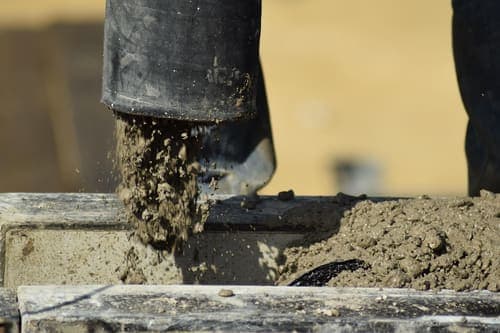
Concrete pumping is how we get a load into a backyard the truck can't reach, and in the older streets around Forest Park and the Hill, that's most of them. A line pump snakes hose through a side gate or down a bulkhead; a boom reaches over the roof when the only way in is up and over. Either way, the mix has to be right. Too stiff and you plug the line, and clearing a plug on a hot July afternoon is nobody's idea of a good time. We keep slump consistent, prime the line, and keep the pour moving so nothing sets up between placements. Most jobs The Springfield Concrete Company pumps run two to four hours on site, whether it's concrete footings in a tight cellar or a patio slab behind the house.
Concrete Flooring
Concrete flooring is the slab you stand on every day, and around here that means a basement in a Forest Park two-family, a garage bay, or a shop floor off Page Boulevard. We set ours over compacted stone and a 10-mil vapor barrier, because moisture wicking up through a slab lifts glue, curls vinyl and hazes out any coating you put down later. Flatness matters just as much. A floor that dips a quarter inch will rock your workbench like a diner table the day you set it down.
Forming, pouring and finishing usually runs three to five days, then we ask you to stay off it for a week and keep heavy loads off for a month. At The Springfield Concrete Company we add fiber to garage floors, since salt tracked off I-91 all winter is unforgiving on a thin slab.
Concrete Footings
Concrete footings are the part of the job nobody ever sees and everybody pays for twice when they're wrong. We dig below the frost line here, four feet down, because a Springfield winter will lift a shallow footing like it owes it money and take your deck, porch or garage slab along for the ride. Typical is an eight inch thick pad, sixteen wide, with two runs of rebar tied in so it's reinforced concrete and not just a mud pie in a hole. Sonotubes for posts, bell bottoms where the soil is soft near the river flats.
What moves the price is depth, soil, access for the truck, and whether we're hand digging or bringing in a machine.
At The Springfield Concrete Company we inspect the trench before any concrete pouring starts. Dig, form, inspect, pour: usually two days.
Concrete Jacking
Concrete jacking is how we save a slab instead of ripping it out. We drill a handful of inch-and-a-half holes through the sunken panel, pump a limestone slurry underneath until the slab floats back to level, then patch the holes flush. A dropped walkway or a corner of a concrete patio usually comes back up in a morning, and you can walk on it before dinner.
Done badly, it's a mess. Lift too fast and the slab snaps clean across. Skip the void where water washed the base out and the whole thing settles again by the next thaw, which around here comes with a couple of freeze cycles in March alone.
What moves the price is how far it dropped, how big the void is, and whether we can get a hose to it. At The Springfield Concrete Company we probe first, then lift.
Concrete Sealing
Concrete sealing is the cheapest hour you'll ever spend on a slab, and it's the one people skip until the surface starts flaking like a bad sunburn. Here's what road salt and forty freeze-thaw cycles a winter do: water gets into the pores, expands, and pops the top layer off in dinner-plate flakes. On a concrete patio or a walkway we usually go with a penetrating silane/siloxane, which soaks in and leaves no film to peel. Acrylics look wetter and richer, but they want a recoat every two or three years and they get slick as the ramp off 291 in the rain unless we broadcast grit into the second pass.
Timing matters. New pours need to cure about 28 days first, the slab has to be dry, and we want daytime temps above 50, so The Springfield Concrete Company books most sealing for September and early October, before the first hard freeze. Seal a damp slab and you'll get a milky white blush that only comes off with a stripper and a bad afternoon.
Concrete Acid Stain
Concrete acid stain is a chemical reaction, not a coat of color sitting on top, so the acid and metallic salts bite into the lime in your slab and leave that mottled, leathery, no-two-spots-alike look you can't get from paint. We use it on basement floors, sunrooms and patios all over Springfield, and if your slab is too chewed up to take stain honestly, we'll put down a concrete overlay first and stain that instead.
The step people skip is neutralizing. Leave acid residue under the sealer and it peels in sheets by the following spring, usually right where the sun hits.
Age of the slab, how hard it was troweled, and whether it needs patching all change what the job runs. Concrete sealing is part of the price, not an upsell.
Ask us and we'll bring samples out.
Concrete Lifting
Concrete lifting is what I'd rather sell you than a teardown, because a settled walk or garage apron usually doesn't need replacing, it needs to go back where it started. We drill penny-sized ports, inject polyurethane foam under the slab, and the void fills and the panel comes up to grade while you stand there watching. Foam cures hard in about fifteen minutes, so you can drive on it the same afternoon. Most jobs are a morning.
What moves the number is how far the slab dropped, how many panels, and whether we can get a hose to it.
Done badly, nobody finds out why it sank. At The Springfield Concrete Company we chase the downspout or the washed-out base first, then patch the ports and finish with joint work and concrete sealing so our Springfield winters don't undo it.
Concrete Overlay
A concrete overlay is how we make a tired but structurally sound slab look new without tearing it out, and on a patio off Sumner Avenue or a garage floor in Indian Orchard that saves you a demo bill and a week of dust. The catch is the prep. We grind or shot blast the surface first, because an overlay bonded to dirt and old sealer will sheet off in flakes the first February the salt and freeze-thaw get at it. Then a bond coat, then a quarter-inch of polymer-modified mix troweled out by a concrete finisher who knows how fast it skins over.
Foot traffic the next day, cars after about three. We need daytime temps over 50, so realistically April through October here.
The Springfield Concrete Company won't overlay a slab that's still moving.
What the job involves
What the job involves changes from pour to pour, but the bones don't. We dig, compact a gravel base, and set forms dead level before a truck ever backs down your street. Then mesh or bar, because reinforced concrete is what holds a slab together when February in the Valley freezes it and thaws it twice in a week. The concrete pouring is the loud part and the short part. A two car driveway is usually one morning.
What decides whether you still like it in ten years is the hour after that: screed, float, joints cut every ten feet or so, so the slab cracks where we put the line instead of where it feels like it. At The Springfield Concrete Company a concrete finisher stays until it's broomed and covered. Skip the base compaction and you own a birdbath by April.
What it costs
What it costs depends more on what's under the slab than what's on top of it. Concrete pouring onto a flat, clean subgrade is one figure; the same square footage on a soft, root-riddled yard off Sumner Ave means excavation, gravel, and compaction before we ever call the truck. Thickness moves it too. Four inches with fiber is not six inches of reinforced concrete with rebar sitting on chairs, and a driveway that parks a loaded pickup needs the second one. Finish is the other lever, broom versus exposed aggregate versus a hand-troweled edge that takes a finisher an extra few hours in the sun.
Call The Springfield Concrete Company at (417) 464-6822 and we'll measure it and quote your actual job, not a guess.
One more thing: pours from December into March need blankets and heated water, and that shows up on the invoice.
Why choose us for this
You've got a cracked slab, a sinking walk, maybe a stoop pulling away from the house, and what you actually want is to hire somebody once and not think about it again for years. So why choose us for this instead of the cheaper number? Look at what we won't do.
We won't quote one figure on the phone and let it grow on the invoice. We won't start a second job across town with your forms still standing. We won't push you to sign today. We won't leave washout in your grass or busted concrete stacked by the curb.
We're not the cheapest quote you'll get, and that's deliberate. Proper subbase, real reinforced concrete, and a concrete finisher who stays until the surface is right take hours some crews skip, and one Springfield freeze and thaw finds every one of those shortcuts. An estimate from The Springfield Concrete Company costs you nothing and commits you to nothing.
Frequently asked questions
Can you pour concrete here in the winter?
Yes, well into the cold months, with limits. Once daytime temperatures sit below about 40 degrees we blanket the slab and keep it covered for the first few days, and if there's frost down in the subgrade we wait, because concrete pouring over frozen ground gives you a slab that settles the minute it thaws. Late fall and early spring are honestly better than August, when a 90 degree afternoon flashes the surface before the concrete finisher can close it.
Should I patch my slab or replace it?
Patch when the cracks are hairline and the sections are still sitting level with each other. Replace when the slab has broken into a dozen floating pieces or the edges have dropped an inch, because that's the base failing, not the concrete. We'll saw a bad section out with concrete cutting and tie the new pour into the old with dowels where that makes sense.
How long am I without the driveway?
Figure a day of demo, a day of forming and reinforced concrete steel, and the pour. You can walk on it the next day, park a car after 7 days, and keep the loaded truck off it for 28.
How do we get started?
Call The Springfield Concrete Company at (417) 464-6822 and I'll come look at it myself, measure, and tell you what the base under there is really doing.