A loading dock that's dropped two inches, or a floor slab cracked into a jigsaw your forklift bounces over.
Nobody has ever called me excited about concrete. You call because the dock has settled, because the slab under your kitchen line has cracked apart, or because a tenant is done asking nicely.
That's the work. We're the commercial concrete company people ring when the fun part of owning a building is over, and we've poured, patched, leveled and sealed for warehouses, restaurants, apartment blocks and storefronts from downtown out toward the Hall of Fame. You won't get talked at about slump and rebar like you should already know it, and no chute washout hardens in the corner of your lot.
Square footage, truck access to the pour, how deep we dig and the shape the old slab has gotten into all set the number on commercial concrete services.
Keep going for how the work actually runs, then ring (413) 547-4797 and we'll walk the site together.
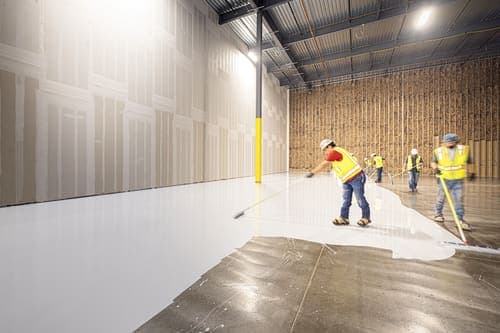
Commercial Concrete Sealing
Commercial concrete sealing is the cheap insurance nobody thinks about until a loading dock starts flaking like a bad sunburn. Road salt and our freeze cycles get into open pores, water expands, and the top eighth inch pops off. On exterior slabs and dock aprons we use a penetrating silane siloxane that soaks in instead of sitting on top, two passes with a squeegee and back roll, applied on a dry slab when the air is above 50 and climbing.
Skip the degreasing step and it beads off the oil spots like nothing happened.
Fall, before the first hard freeze, is our busy window. Most traffic surfaces want another coat every two to four years.
If you have a slab worth protecting, The Springfield Concrete Company would rather seal it than saw it out later.
Commercial Concrete Construction
Commercial concrete construction is the heavy end of what we do: loading docks, warehouse floors, footings, equipment pads, generator bases, and the walks around a building that has to keep taking deliveries while we pour. We set the steel to the drawings instead of eyeballing it, and we saw the control joints inside the first day, because every slab cracks eventually and the only real question is whether you picked the line or it picked one for you.
Mix matters just as much. A fiber-reinforced pour rated for forklift traffic behaves very differently than whatever was cheapest on the truck that morning.
What moves the number is square footage, slab thickness, how much old concrete has to come out, and whether a mixer can back within a hose length of the pour. Winter adds blankets, heated water, and patience.
Commercial Cement Flooring
Commercial cement flooring is the slab your people walk on every day and never think about until it dusts, curls, or cracks straight through the middle of an aisle. We pour interior floors for warehouses, shops and commercial kitchens here, and most of the work happens before the truck backs in: a level stone base, a 10 or 15 mil vapor barrier lapped and taped at the seams, and a mix nobody gets to add water to on site.
Water down the load and you get a floor that sands off under a pallet jack inside two years. We saw the control joints the same day, usually inside 12 hours, so the slab cracks where we tell it to. Forklift traffic waits about a week, and glued-down finishes wait on a moisture test, not a hunch. Plenty of commercial concrete contractors skip that test.
Commercial Concrete Floor Coatings
Commercial concrete floor coatings live or die on the prep, not on the label on the pail. We shot blast the slab back to bare concrete, grind the perimeter and around columns, chase and fill the cracks, then run a moisture test before anything gets mixed. Coat a slab that's still pushing vapor and the epoxy blisters and peels in sheets, usually right where the forklifts turn.
In a warehouse or a commissary kitchen I'll usually push you toward urethane cement instead of straight epoxy, since it takes hot water and thermal shock without letting go. A machine shop gets a topcoat that shrugs off oil.
Most floors we coat go down over a couple of days so you open on schedule. Size, the shape the slab is in, and how much of your operating shift we have to dodge are what move the number.
Commercial Polished Concrete
Commercial polished concrete is the floor you already own, ground flat and brought up to a shine, and it's the job retail and warehouse owners along Boston Road ask me about most. We start with metal-bond diamonds around 30 and 40 grit to open the surface, settle with you on how much stone you want showing, then work up through the resin grits to 1500 or 3000 depending on the gloss you're after.
A lithium silicate densifier goes on partway through the run, not slapped on at the end, and control joints get filled with semi-rigid epoxy so forklift wheels stop chewing the edges.
Skip grits to save a day and you'll see swirl marks under the lights until the building falls down. Slab age, old tile mastic and how much aggregate you want exposed move the price far more than square footage. Most floors The Springfield Concrete Company polishes take a few days, worked in sections so you stay open.
What the job involves
What the job involves on a commercial slab is mostly the part nobody ever sees. Before a mixer backs in, we dig out, build and tamp a stone base, set the rebar or mesh, and lay a vapor barrier under any interior floor. Skip that barrier and the coating blisters off the surface inside a year, and you pay for the floor twice.
Then it's pour, screed, float, and cut the control joints that same day. Cut them late and the slab picks its own crack line, usually straight across the loading dock doorway.
What moves the price on commercial concrete work: square footage, slab thickness, how close we can get a truck, whether there's old concrete to break out first, and the season. A cold-month pour needs blankets, heat and a few more days before anything rolls on it.
What it costs
What it costs on a commercial concrete job comes down to five things: how many square feet, how thick the slab has to be, what's sitting under it now, how close we can get a mixer to the pour, and the time of year you want it poured. A dock apron taking box truck traffic all day needs more steel and more depth than a slab behind a break room, and it prices that way.
Tearing out a broken slab adds a day and a dumpster. Cold-weather pours mean blankets and admixtures.
Most commercial concrete contractors won't give you a number over the phone, and neither will we until we've walked it. Call us at (413) 547-4797 and we'll come look.
Sunken bays are often worth lifting rather than replacing, so we price commercial concrete leveling first and rebuild only when the subgrade is past saving.
When commercial concrete is the wrong fix
Sometimes commercial concrete is the wrong fix, and telling you that costs me the pour.
If a slab has settled but the surface is still sound, ripping it out is money burned. Commercial concrete leveling puts it back where it belongs and you keep the steel that is already in it. One spalled edge, one blown joint, one bad bay in the middle of a good floor? That is concrete repair, not a new floor.
And if the cracking traces back to a footing that is moving, fresh concrete poured over it splits again along the same line inside a year, so commercial foundation contractors need to look at it before anybody talks about slabs.
If it is your house rather than a loading dock, that is our residential side: a concrete driveway, curbs along the beds, stamped concrete or other decorative concrete finishes out back.
Why choose us for this
Before you choose us for this, picture your Monday: forklifts hammering a spalling slab by the dock door, a puddle that never dries, and zero interest in dealing with it again in two winters.
No number that grows: What we quote is what we bill, unless you change the scope mid job.
No vanishing crew: We don't start a second pour across town while yours sits half finished under plastic.
No pressure to sign: The estimate is free and it keeps until you're ready.
No mess left behind: Forms, offcuts and washout leave on our truck, not in your dumpster.
We aren't the cheapest of the commercial concrete contractors bidding your building, and that's deliberate. Proper subgrade prep and control joints take a day nobody sees. Hire The Springfield Concrete Company once, and commercial concrete services stop being something you think about.
Frequently asked questions
Do I need my slab replaced, or can it just be lifted?
Usually lifted. Commercial concrete leveling pumps polyurethane foam through holes about the size of a dime, and you're driving on that bay the same afternoon. Replacement is the call when a slab has broken into several pieces, or the surface is spalling and crumbling under wheel load. We'll tell you which one you've got before we quote it.
How long am I out of use after a pour?
Foot traffic at 24 to 48 hours, trucks at seven days, full design strength at 28. Under 40 degrees we blanket it, which slows the schedule but beats a slab that freezes before it sets.
What moves the price on commercial concrete services?
Square footage, slab thickness, truck access, the shape the old surface got into, and the time of year.
Contact The Springfield Concrete Company now
Need a commercial concrete company in Springfield now, before the next delivery truck bounces through that sunken bay? Reach us at (413) 547-4797. We're there nine to five on weekdays, and a message left after that gets returned by me, not a call center.
When you call, tell me what the space is used for, roughly how many square feet, and what's actually failing: dusting under the racking, a joint spalling at the edge, a dock apron that's dropped. Then I come look at it. Plenty of the time commercial concrete leveling and a sealer buys a building owner a few more years. Sometimes the slab is past saving and we talk about pouring new.
Square footage, how much has to come out, how we get equipment through your door and how many hours you can give us the space change the job most.