Nobody wakes up excited about concrete flatwork, and yet here you are, staring at a Springfield sidewalk that's heaved up like it's trying to get a better view of the Big E traffic.
We pour flatwork for houses all over the city and out through Chicopee, West Springfield and Wilbraham. What we won't do is dump mud on a soft base and call it a driveway, because our winters find that shortcut by March. As concrete contractors in Springfield, we show up when we said we would, we answer the phone ourselves, we don't talk over you at your own kitchen table, and we take the broken pieces with us.
Below you'll find how we build a concrete sidewalk, what changes the price, the stamped work people ask for, and the questions we get most. Call us at (417) 464-6822 and I'll come look at it myself.
Concrete Deck Footings
Concrete deck footings are the part nobody sees and everybody feels, because a deck that bounces or pulls away from the house usually started with a hole that wasn't deep enough. We dig to below the frost line, which in this part of Massachusetts means about four feet, and we pour into sonotubes with a belled base so a February freeze can't lift the whole thing like a hydraulic jack. Post bases get set on standoffs, an inch off the concrete, so the post bottoms aren't sitting in snowmelt every March and rotting from the ground up.
What moves the price is depth, ledge, access for a machine, and how many piers your plan calls for.
We get the footings inspected before backfill, same as any of the concrete contractors in Springfield working under the state code.
Concrete Sidewalk
A concrete sidewalk takes more abuse than anything else we pour, between the plow blade in February and the maple roots lifting panels along Sumner Avenue. We dig to a compacted gravel base, pour four inches of air-entrained mix, and cut control joints every four to five feet so the slab cracks where we tell it to instead of wherever it feels like. Pitch matters too, about a quarter inch of fall per foot, or you've got a skating rink out front every January. The walks that heave by the second winter are almost always the ones where somebody skipped the base and hoped. Most runs are a day of prep and a morning of pouring, light foot traffic a day or two later. We're concrete contractors in Springfield who'd rather cut the roots back than pour over them and pretend.
Concrete Slab With Rebar
A concrete slab with rebar is the one I argue about most, because the steel only earns its keep if it sits where it belongs. We tie a grid of half inch bar at sixteen to twenty four inches on center and set it on chairs so it lands in the middle of the pour, not flat on the stone getting hooked up with a rake halfway through. Steel lying on the base is decoration. Under it goes six inches of compacted process, and we saw the control joints the next morning, before the first cold night does it for us.
Most slabs take us two days of forming and steel and one to pour. Walk on it the next day, park on it in a week.
That order matters, and good concrete contractors in Springfield don't skip it.
Stamped Concrete Walkway
A stamped concrete walkway takes more crew and more hustle than any other piece of flatwork we pour, because the clock starts the second the mud goes down. We set the base, pour four inches, broadcast color hardener, then work the mats across while the slab is still soft enough to take a crisp impression. In August you might get forty minutes. Blow that window and the pattern comes out shallow and washed out, and no sealer on earth fixes it.
Then it needs cure time and a sealer before the first salt truck rolls down your street, because Springfield winters chew on anything left bare.
We're one of the few concrete contractors in Springfield who'll postpone a stamped pour when the forecast turns. Better a week late than a walkway you squint at for twenty years.
Stamp Overlay Concrete
Stamp overlay concrete is how we give a tired patio or pool deck a new face without breaking out the old one, a quarter inch or so of polymer-modified mix bonded down, stamped, then colored and sealed. The catch is the slab underneath. If it's heaved, hollow, or running a crack that moves with the seasons, that crack telegraphs straight through by the first thaw, and no amount of pretty stamping hides it. So we grind or shot blast the surface, wash it, prime it with a bond coat, and only then go to work. Skip that step and the overlay peels in sheets like old wallpaper.
Most overlays we pour take a day to place and stamp, foot traffic the next day, furniture and grills later that week. Salt is the enemy here, so we reseal on a two-year rhythm. Not every surface is a candidate, and we'd rather tell you that up front than sell you one, which is a habit that has kept us busy as concrete contractors in Springfield.
Concrete Walkway Installation
Concrete walkway installation is mostly a base job, no matter how pretty the top ends up looking. We strip the loam, dig down eight to twelve inches, compact process stone in lifts, then pour four inches on top with control joints tooled every four or five feet so the walk cracks where we tell it to instead of where February decides. Skip that base and by March you've got a path that's heaved an inch and catches the mail carrier's toe.
Curves, steps and tearing out a crumbling old walk move the number far more than the square footage does.
Most walks are a one or two day pour, light foot traffic in about 24 hours, seven days before anything heavy. And no rock salt the first winter. Folks hiring concrete contractors in Springfield always ask, and yes, new concrete flatwork really does hate de-icer.
Concrete Restoration
Concrete restoration is what I recommend on about half the slabs I get called out to look at, because a tear-out isn't always the answer. Road salt and the plows that come down Sumner Ave chew the top eighth of an inch off a surface, and once that paste is gone you get spalling that spreads a little wider every March. If the concrete underneath is sound, we grind it, patch the pop-outs and bond a polymer-modified overlay over the whole panel.
Settling is a different animal. Jacking concrete slab sections back to level with polyurethane foam takes most of a day and saves the pour.
What moves the price is how far off level it's sitting, how many control joints need cutting and resealing, and whether tree roots did it, because roots come back. We're one of the few concrete contractors in Springfield who'll tell you straight when a panel is past saving.
Slate Concrete Stamp
A slate concrete stamp is the pattern I get asked for more than any other, and I understand why: it reads like real stone without the joints that heave every March. We use seamless slate skins, so the texture wanders instead of repeating in a grid you can never unsee once you've spotted it. Timing is the whole job. Press the mats into a concrete slab too early and they sink and float the cream; too late and you get a shallow impression that's gone after two winters of salt and plows. My crew watches that thumbprint window, works in from the edges, then hand-tools the tight spots around steps and posts. Color hardener goes in with a release powder for the shadowing, and we cut the joints along the pattern lines so cracks land where we put them, not where they feel like it.
Brick Concrete Stamp
A brick concrete stamp gives you the running bond look of an old city sidewalk without sixty loose bricks working their way loose every spring. Timing is the whole job. We stamp when the slab takes a thumbprint and holds it, which on a hot July afternoon can be a twenty minute window. Go early and the mat sinks and the joints close up. Go late and you get a faint waffle print nobody wanted to pay for.
We border the pour with a soldier course so the pattern ends on purpose instead of dying halfway through a brick in the corner, and we cut control joints into the grout lines where they disappear. Plenty of concrete contractors in Springfield skip that step, and then the freeze thaw crack picks its own route right across your pattern.
What the job involves
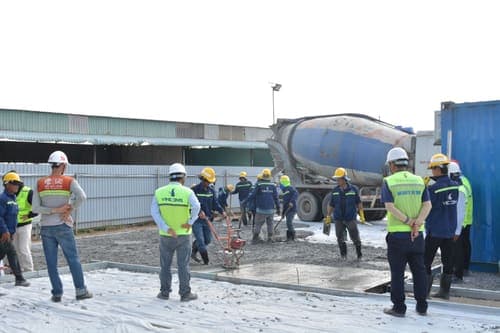
What the job involves, start to finish, is more digging than pouring. On most concrete flatwork we strip the topsoil, bring in six inches or so of processed gravel, and compact it in lifts until the plate compactor stops sinking. Then forms, then steel sitting up on chairs where it belongs. Pouring the slab is the quick part; a twenty by twenty pad goes down in a morning. The finishing is what decides your future: screed, bull float, clean edges, and control joints cut before the mud sets hard. Skip those joints and by the second Springfield winter you've got a crack wide enough to lose a quarter in. Thickness, truck access, and how much soft soil we haul off the site are what move the number. As concrete contractors in Springfield, we build for freeze and thaw, not for a photo in June.
What it costs
I can't tell you what it costs to pour your concrete flatwork without asking a few questions first, and anybody who quotes you blind is guessing. Square footage matters less than people expect. What really moves a concrete slab cost is the prep: how much old concrete has to come out, whether the subgrade needs six inches of processed gravel, and whether the mixer can back up to the pour or we're wheelbarrowing it around a Forest Park triple-decker. A concrete slab with rebar runs higher than wire mesh, and on anything that takes vehicle weight it's worth the difference. Stamping and color add a day and a release step. February pours need blankets and hot water, too.
Call us at (417) 464-6822 and we'll come measure. We're concrete contractors in Springfield who price off the site, not off a guess.
Why choose us for this
You've got a slab tipped toward the house, or a walk that catches a toe every time you go for the mail, and you'd like to deal with it once and never think about it again.
No price that grows: what I write on the estimate is what lands on the invoice unless you change the scope.
No disappearing crew: we don't go start a patio in Sixteen Acres while your forms are still standing.
No pressure to sign: sit with it a week. The estimate costs you nothing and books nothing.
No mess: forms, chunks and washout leave with us, not next spring.
I'm not the cheapest of the concrete flatwork contractors you'll call, and that's deliberate. Base prep and steel are where the cheap number comes from, and they're the two things I won't shortchange. Plenty of concrete contractors in Springfield pour fast in October. Ours are still flat in April.
Frequently asked questions
Can I walk on a new concrete slab right away?
Give it 24 to 48 hours for foot traffic, seven days before you park on it, and 28 days for the full cure. We pour flatwork in the morning when we can, because a July afternoon in the 90s flashes the surface off fast and that's how you get crazing. Below 40 degrees we blanket it. My sidewalk has sunk at one corner. Repair or replace? If the panel is sound and just settled, jacking a concrete slab back to grade is usually the right call and you keep the existing concrete sidewalk. If it's cracked through, spalled from road salt, or rocking underfoot, patching only buys a winter. Then it's a tear-out and repour.
How do we start?
Call the concrete contractors in Springfield at (417) 464-6822 and I'll come measure.