Most concrete repair in Springfield starts the same way. You back out toward Sumner Ave, the tire drops into that one corner of the slab, and the coffee ends up in the cupholder's general vicinity. Frost got under there in February, water followed, and now the driveway is telling on you.
That's what our concrete contractors company does all week, from Forest Park to Indian Orchard to the streets around Six Flags in Agawam: cracked concrete, sunken walks, steps that rock when you stand on them.
Here's my promise on conduct. We show up the day we said, we don't talk down to you, we don't push work you don't need, and we sweep up.
Below is how the repair actually goes, what moves the price, and the questions folks ask first. Call me at (417) 464-6822 and I'll come look.
Cement Crack Repair
Cement crack repair starts with a diamond crack chaser blade, not a caulk tube squeezed over the top. We saw the crack out to a clean quarter inch V, vacuum the dust, and only then fill it. What goes in depends on what the crack is doing. A dormant hairline in a garage slab takes a low viscosity epoxy concrete repair that bonds both faces back into one piece. A crack that opens every January and closes by July gets a flexible polyurethane instead, because epoxy in a moving joint just splits again two inches over, and now you own two cracks.
Crack filling over damp, dusty concrete is the failure I see most around Springfield. It looks great for a winter, then peels up like an old bumper sticker.
Concrete Crack Repair
Concrete crack repair starts with figuring out whether the crack is still moving. A hairline in a garage slab that hasn't budged in three winters is one thing. A crack that's wider at one end, with one side lipped up a quarter inch, is telling you the base underneath washed out, and filling that is like putting a fresh coat of wax on a flat tire.
So we chase the crack open with a diamond blade, vacuum it out, and fill it based on what it's doing: a rigid epoxy concrete repair where the slab needs to be knitted back together, backer rod and a flexible sealant where it needs room to breathe through a Springfield February. Most cracked concrete on a walk or a single drive is a morning's work. Below roughly 40 degrees the material won't cure properly, so our concrete contractors company holds those jobs for a warmer stretch.
Concrete Patching
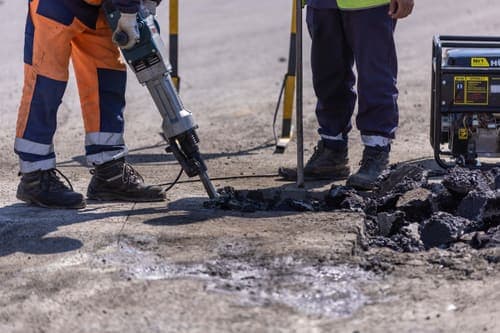
Concrete patching is what we do when one section of a slab has crumbled away and the rest of it is perfectly sound, and that covers a good share of the concrete repair calls we take around Springfield. The mistake I see over and over is a thin skim feathered out over a shallow chip. Those edges are paper at the perimeter, and by the second thaw off the Connecticut River they curl and pop right off. So we saw-cut the bad area square, go down a full inch or better, vacuum and wash the dust out, brush on a bonding slurry and pack it with polymer-modified mortar. On a garage floor or a concrete sidewalk repair that takes plow blades and steel wheels, our concrete contractors company switches to an epoxy concrete repair mortar, walkable in hours. Most patching wraps in a day, full cure in about a week.
Concrete Driveway Repair
Concrete driveway repair is most of what we do once the frost comes out of the ground in March, and it usually starts the same way: one panel has dropped half an inch, water pools there, and by the next winter that low spot is a crack you can put a pencil in. We saw out the failed section, dig down, and fix what actually caused it, which is nearly always a soft or washed out base under the slab. Patch over bad gravel and you get the same cracked concrete back in two seasons, guaranteed.
Most driveways here need a day of demo and prep, a day to pour, and then you stay off it with the car for about a week. Plow damage along the apron and salt spalling near the garage get handled at the same time by our concrete contractors company.
Seal Cracks In Concrete
When we seal cracks in concrete, we're not just running a bead of caulk down the gap and calling it done. We open the crack with a crack chaser blade, blow it clean with compressed air, drop backer rod into anything deeper than half an inch, then fill it with a self-leveling polyurethane that stays flexible while your slab moves all February. A broadcast of sand over the top keeps it from looking like a shiny gray worm crossing your walk.
Timing matters. Under about 40 degrees the sealant skins over wrong, so we like crack filling wrapped up before the first hard freeze.
Skip the prep and water sneaks under the fill, freezes, and pries the crack wider. That prep is most of the job, and our concrete contractors company doesn't shortcut it.
Spalling Concrete
Spalling concrete is the surface flaking off in dime sized chips until the gray aggregate underneath shows through, and once it starts it doesn't stop on its own. Road salt off the plow trucks works into the top eighth of an inch, water follows the salt, and every hard freeze in January pops another piece loose. We grind back to sound material, clean it properly, then bond a polymer modified overlay across the whole surface so it wears as one piece instead of looking like a quilt. Skip the bonding agent and the repair sheets right off by spring, which is the most common callback our concrete contractors company gets sent to fix after someone else. Most concrete spalling repair on a walk or a set of steps runs a day, plus 24 to 48 hours before you use it.
Fill Cracks In Driveway
When we fill cracks in driveway slabs, the first thing we do is open them up, not cover them. A wire wheel or a crack chaser gets us down to clean concrete on both faces, then we blow the dust out with compressed air, drop in backer rod on anything deeper than half an inch, and fill with a self leveling polyurethane that flexes when the slab moves in January. Most driveways are a half day of crack filling, and you stay off it overnight.
Skip the cleaning step and the sealant lets go by the first February thaw, usually right when the plow catches the edge.
Hairlines can wait a season. Anything you can fit a nickel into is taking water, and that is how a cracked concrete slab turns into concrete driveway repair. Our concrete contractors company would rather chase the crack now.
Concrete Spalling Repair
Concrete spalling repair is what you need when the top layer of your slab starts flaking off in dinner-plate patches, usually because road salt tracked home off I-91 spent all February eating the surface. We chip back to sound concrete, saw a clean edge so the patch has something to grip, wire-brush any rebar that's rusting underneath, then bond in a polymer-modified mortar. Skip the sound edge and you get a skim coat that pops off by the next thaw, which is why our concrete contractors company won't feather a repair down to nothing.
Most spalled walks and steps take us a day, sometimes two. Foot traffic after 24 hours, car weight after a week.
What moves the number is depth, square footage, and whether the steel below has already started swelling.
Recover Concrete Driveway
You can recover concrete driveway slabs that look past saving more often than people think, and that's the call we make on plenty of surfaces in Sixteen Acres and East Forest Park. If the base underneath is still solid and the cracked concrete is hairline stuff, we grind the top, prep it properly, and bond a polymer-modified overlay about a quarter inch thick over the whole thing. Figure two days, one for prep and one for the pour, then 48 hours before your truck sits on it.
Skip the prep and that overlay sheets off by the second March thaw. It's a rug over a hole in the floor.
When the slab has sunk or the cracks run full depth, an overlay only hides it, and our concrete contractors company will say so and talk replacement instead.
Stamped Concrete Sealing
Stamped concrete sealing is the chore people put off until the patio looks like a washed out photo of itself. The color lives in the top eighth of an inch, and once the sealer gives up, Massachusetts freeze-thaw and the salt tracked off your walk start lifting it right out. Most patios here want a recoat every two to three years, sooner if it faces south and bakes all summer.
We wash it, let it dry a full day, then put down two thin coats of solvent-based acrylic with an anti-slip additive mixed in, because wet stamped stone without grit is a slapstick routine waiting to happen. Thin is the whole trick. Lay it on heavy and you get white blushing where moisture gets trapped under the film, plus tire marks by August.
Any stamped work our concrete contractors company pours gets sealed before we pack up, and we tell you when it's due again.
Crack In Basement Floor
A crack in basement floor slabs is usually one of two animals, and telling them apart is most of the job. Hairline shrinkage cracks show up as the slab cures and they're cosmetic. The ones that widen, lip up on one side, or push water across the floor every time the Connecticut River comes up in spring, those are settlement, and patching the top of them is like putting a bandaid on a leaky pipe.
We grind the crack open, vacuum the dust out, and fill it properly. Dry cracks take a polyurethane or epoxy concrete repair injection that bonds edge to edge instead of sitting on the surface. Wet ones get a flexible resin that can take the movement.
Most basement repair work like this runs a few hours, and our concrete contractors company will tell you straight if the slab needs more than a fill.
Concrete Step Repair
Concrete step repair is the job we get called for most once the snow melts, because rock salt and the plow blade spend all winter chewing on your treads. What usually happens is the nose of the step goes first, water sneaks in behind the patch somebody troweled on last spring, and by April you've got a bite missing right where the mail carrier plants her foot.
We chip back to sound concrete instead of skimming over crumbs, brush on a bonding agent, form the riser, and rebuild it. Loose handrail posts and hollow treads get pinned, and epoxy concrete repair is what holds them. Keep your risers within about a quarter inch of each other and nobody trips in the dark.
Most weeks our concrete contractors company has a set of steps torn apart somewhere between Forest Park and Indian Orchard. Give new work a day or two before heavy traffic.
What the job involves
What the job involves depends on what we find once the loose material comes out, so the first thing we do is sound the slab with a hammer and mark everything that answers back hollow. On a standard concrete repair we saw cut a clean edge about half an inch deep, chip back to solid material, vacuum the dust, then bond in a polymer-modified mortar so the patch grips instead of sitting on top like a coaster. Cracked concrete that's still moving gets routed and filled with something flexible, because a rigid fill just splits again a foot over by March.
Depth, access and how much of the slab is shot are what move the price on concrete slab repair.
Most flatwork our concrete contractors company patches takes foot traffic in 24 hours and vehicles in three days, and we need pavement temperatures above 50 degrees.
What it costs
What it costs depends entirely on what's actually broken, and I'd be doing you no favors pretending there's one number. Concrete repair on a hairline in a two-year-old walkway is an hour with a grinder and some polyurea. Spalling concrete across a whole driveway apron, the kind the salt trucks chew up on Sumner Ave every February, is a different animal and often means resurfacing rather than patching a slab.
What moves the price: square footage, how deep the damage runs, whether we can get a truck near it, and whether the ground underneath has settled. Concrete step repair runs higher per foot than flatwork because somebody has to build forms.
Call our concrete contractors company at (417) 464-6822 and we'll walk your job. Most repairs are a one-day visit. The cure time before you park on it is the longer wait.
Why choose us for this
You've got cracked concrete out front, you've been stepping around it since the last thaw, and what you actually want is to hire this concrete repair out once and never think about it again. Fair enough. So here's what our concrete contractors company won't do to you.
Move the number: the price I write down is the price on the invoice, unless you change the scope.
Vanish mid-job: we don't start a second slab across town while yours sits torn up.
Push you to sign today: the estimate costs nothing and there's no obligation to book it.
Leave the mess: broken concrete, forms and dust go out on the truck.
I'm not the cheapest quote you'll get. Prepping a concrete slab repair properly, saw-cut edges, clean substrate, takes hours a fast crew skips, and you see the difference three winters later.
Frequently asked questions
Can you repair my concrete, or do I have to tear it out?
Most of it we repair. If the cracks are under a quarter inch, the slab isn't rocking underfoot and the spalling is shallower than about half an inch, concrete slab repair is the honest call. When a walk has broken into four pieces that move independently, or the base under it has washed out, patching just buys you a season. Replacement wins there. Same test for a concrete step repair: sound core, we rebuild the face; crumbling core, it comes out.
How long am I off it after the work?
Foot traffic in about 24 hours, vehicles in three to seven days depending on the mix and the weather. An epoxy concrete repair on a crack in basement floor cures faster, usually overnight. Once the nights drop under 40 degrees around here, everything slows down, which is why we push concrete sidewalk repair and driveway work into May through October when we can.
What if the crack opens up again?
Cracked concrete comes back when the problem underneath it was never fixed, so we chase the cause first: bad drainage, a void under the slab, frost heave from a shallow base. I'll tell you straight if a repair is cosmetic and likely to reappear in two or three winters. Some are, and you should know that before we start, not after.
How do we get started?
Call our concrete contractors company at (417) 464-6822 and we'll come look at it, usually within a few days. Weekdays nine to five, and Saturdays when something genuinely can't wait.