Springfield curbs live a hard life. Between the plow blade on Sumner Ave every February, the salt that follows it, and the delivery truck that swings wide into your apron at seven in the morning, the edge of your property takes punishment nothing else on the lot does.
We pour concrete curbing all over the city, plus West Springfield, Chicopee, Ludlow and out through Sixteen Acres. How we work is simple. We show up the day we said we would. We don't lean on you, we don't talk over your head, and you get a person on the phone instead of a mailbox. When we pull out, the forms, the stakes and the wash water go with us.
Keep reading for how the work actually goes, what changes the price, and the questions people ask first. Or call me at (417) 464-6822 and I'll come take a look.
Concrete Curbs
Concrete curbs are the piece of your property that takes the beating nobody plans for, and we pour them all over Springfield, from parking lots off Boston Road to driveway edges in Sixteen Acres and Forest Park. A curb does two jobs: it tells water where to go, and it stops tires from chewing the lawn every time somebody backs out. Done right, the concrete curbing is set on a compacted base, poured at a consistent height, and jointed so winter has somewhere to move. Done wrong, you get a wavy line and a chunk that pops off the first time a plow driver clips it in February. What moves the price is length, height, how much demo comes first, and whether we're working around existing pavement. At The Springfield Concrete Company we form curbs to hold that line for decades.
Gutter Curb
Gutter curb is the one where water decides whether you did it right, because the pan and the curb come out of the same pour and the pan has to actually move water toward the catch basin. We string line for a consistent fall, usually about a quarter inch per foot, and we check it with water before anyone signs off. A flat spot in the pan looks fine in July. Come February that puddle freezes, a plow blade catches the lip, and you have a chunk of concrete curbing sitting in the snowbank like it was never attached.
We pour on compacted process stone, use an air entrained mix for our winters, and keep traffic off it while it cures.
Half the drainage repairs The Springfield Concrete Company gets called for started as a gutter pan poured by eye.
Concrete Curb Installation
Concrete curb installation starts underground, which is why so much of it fails up here. We dig out the soft stuff, put down six inches of compacted process gravel, and pin the forms straight before a single wheelbarrow shows up. Skip the base and your new curbs ride the frost every March, tipping and cracking like the potholes on Sumner Ave.
We pour an air entrained mix, tool the joints every eight to ten feet so the concrete cracks where we tell it to, and cure it properly instead of letting the July sun cook it dry. Keep vehicles off for about a week, and no de-icing salt the first winter.
Whether it's concrete curbing along a lot edge or a concrete curb for driveway that a plow keeps clipping, that's the work The Springfield Concrete Company does every season.
Ada Compliant Curb Ramps
ADA compliant curb ramps are the fussiest twenty square feet of concrete we pour, because every number on them is checked with a level, not a thumb. Running slope stays at or under 1:12, cross slope at 2 percent, flared sides at 1:10, and the lip where the ramp meets the gutter line has to be flush within a quarter inch. Miss any of that and the ramp gets torn out, not adjusted.
The detectable warning panels are where corners get cut. Set them wet into the fresh pour, not glued on top after, or the first February plow down State Street peels them like a sticker off a bumper.
Site conditions drive the number more than the ramp does: existing drainage, how much sidewalk and curbing we cut back, and whether the utility box is in the way. At The Springfield Concrete Company we lay out every concrete curb ramp before a single form goes down.
Concrete Curb Forming
Concrete curb forming is where the whole job gets decided, because concrete only remembers the shape you gave it. We pull a string line off your finished grade first, then stake forms every three or four feet, switching to steel or flexible ply on the radius so a curve comes out round instead of faceted like a stop sign. Stakes go below the top of the form so nothing telegraphs into your edge. A form that bellies out under a full chute leaves a wave you'll be looking at from the street for the next twenty winters.
We strip the following day, tool the joints roughly every ten feet, and cure. Skip those joints and the curbing picks its own crack line, usually the first hard February. Forming is the slow part of what my crew at The Springfield Concrete Company does, and it's the part worth the hours.
Cement Curbing
Cement curbing and concrete curbing are the same animal, so don't let anyone upcharge you for the fancier-sounding word. What matters is what goes in the forms. We run a 4,000 psi mix with roughly 6 percent entrained air, because a curb here sees freeze and thaw dozens of times between December and March, and those tiny air pockets give the water somewhere to go when it expands. Skip the air and you get scaling by the second spring, the face flaking off like a bad sunburn.
We tool control joints every eight to ten feet so the curb cracks where we tell it to, cure it under blankets or compound when the nights get cold, and ask you to stay off it with rock salt that first winter. Sand does the same job without eating the surface. At The Springfield Concrete Company I'd rather bore you with mix design in March than patch your curbing in April.
Concrete Curb Ramp
A concrete curb ramp is the one piece of sidewalk everybody uses and nobody notices until it's built wrong. We saw out the old curb section, cut the walk back, then form the landing and the side flares so the running slope stays under 8.33 percent and the cross slope stays nearly flat. The transition down into the gutter curb has to sit flush. A lip of even half an inch stops a wheelchair caster cold, and by January it's a little ice rink.
Detectable warning panels get set while the concrete is still green, not glued down later when they'll pop loose behind the first plow.
We broom finish across the direction of travel, then keep foot traffic off for a few days. At The Springfield Concrete Company we shoot every slope with a level before the forms come off, not after.
Mow Curb
A mow curb is the low strip we pour between your lawn and your beds so the mower wheel rides right on it and you can put the string trimmer back in the garage. Four to six inches wide, poured on a compacted base and troweled slightly below the grass line, with a joint every few feet so a February freeze has somewhere to go instead of cracking the middle. Done wrong, it sits proud, the blade nicks it every Saturday, and by spring you've got a chipped white ribbon around the hostas.
What moves the number is linear footage, how many curves you want, and whether we're cutting out old plastic edging and maple roots first.
Most of the landscape concrete curbing The Springfield Concrete Company pours goes in around beds, walkways and tree rings.
Extruded Curb
Extruded curb is the machine-laid kind, a stiff low-slump mix pushed out through a mold along a string line, no forms and no stakes. We run it around parking lot islands, along asphalt edges, anywhere you need a few hundred feet of curbing in a day instead of a week. That speed is why lots on Boston Road get it.
Where it goes wrong is bonding. Extruded curb sits on top of the asphalt, so if the surface isn't swept clean and tacked, the first February thaw and the first plow blade will send sections skating across the lot like a Bruins winger. We clean and tack, every time.
Mix stiffness, tight radii and how much hand-patching the ends need are what move the price at The Springfield Concrete Company on any extruded run.
Monolithic Curb
A monolithic curb is poured as one piece, curb face and gutter pan together, with no cold joint down the middle for water to sneak into. That joint is where separate pours die around here. Water sits in it, February does its thing, and by spring the curb face is leaning away from the pan like it's had enough. We set forms to grade, pour a stiff air entrained mix, tool the face, and cut contraction joints roughly every ten feet so the cracking happens where we put it instead of wherever it feels like. Keep traffic off for about seven days, longer in cold weather, and backfill behind it once it's set so the soil holds the back of the curb. What changes the job is the length of the run, the radius work, and whether the base under it needs rebuilding first. The Springfield Concrete Company handles concrete curb forming on straight runs and tight radiuses alike, which is most of what curbing work actually is.
Repairing Concrete Curb
Repairing concrete curb is mostly a question of how much you cut out, and the answer is almost always more than the homeowner hoped. A plow blade in February takes a bite out of one section, and the temptation is to trowel a patch over the scar. That feather edge pops off with the first thaw, usually before the Sox report to Fort Myers. So we saw cut back to the nearest sound joint, pull the whole section, drill and epoxy dowels into the ends that stay, then pour against the existing line so the new work doesn't wander.
What moves the number is length, access, and whether the gutter curb pan underneath is shot too. At The Springfield Concrete Company we'll usually have a short run of curbing formed, poured and stripped inside two days, then keep traffic off it for a week.
Decorative Curbing
Decorative curbing is just a curb that got dressed up, and around here that usually means stamped slate or a cobble pattern along a bed line in Forest Park or a front walk off Sumner Ave. We run integral color through the mix rather than dusting the top, because a surface-only color gives up on the leading edge after two winters of shovels and plow wings. Stamping happens while the concrete is still green, so we work fast and in sections. Then joints every three to four feet.
Every decorative pour at The Springfield Concrete Company gets the same joint spacing as a plain concrete curb for a driveway, because pretty concrete cracks exactly like the plain stuff does. Pattern, curve count, and one color versus two are what move the price on decorative concrete curbing.
What the job involves
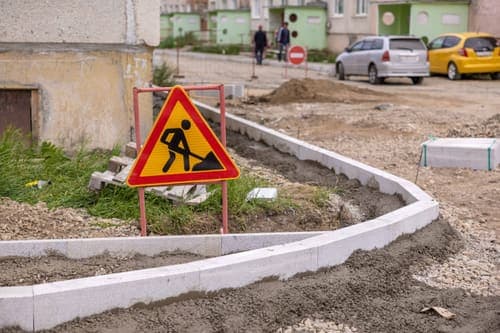
Here's what the job involves, start to finish. We snap a line, dig the subgrade down six inches or so, and compact a gravel base, because curbing set on soft fill goes wavy by the second March thaw and there's no fixing that later. Then it's concrete curb forming by hand where you've got radiuses, returns and aprons, or the machine for long straight runs of extruded curb. We pour an air-entrained mix, tool the face and the top, cut control joints about every ten feet, cure it, then strip and backfill so the grass side sits tight.
Most driveway runs we do at The Springfield Concrete Company take a day or two, plus a few days before anything heavy rolls over it.
Length, height, how many curves, and whether we're breaking out old concrete curbs first are what move the number.
What it costs
What it costs comes down to length, shape, and whatever's already sitting there. A straight run of extruded curb along a flat lot edge moves fast. Curves, radius corners and a concrete curb for driveway entrances all get formed by hand, and hand work takes hours a machine doesn't. Tearing out cracked curbs and hauling the rubble off adds a day. ADA compliant curb ramps run higher because the slope tolerances and detectable warning panels leave nothing to eyeball. Subgrade swings it too. If we dig in and find soft fill, we compact and stone it before a drop of concrete goes down.
Call The Springfield Concrete Company at (417) 464-6822 with your rough footage and we'll talk through concrete curbing cost on your actual job.
The cheap bid usually skips the base, and Springfield winters collect on that debt.
Why choose us for this
You've got curbs that are chipping at the edges, sinking at one end, or sending water somewhere it has no business going, and what you actually want is to handle it once and never think about it again.
So here's what we won't do.
We won't quote one number over the phone and hand you a bigger one at the end. We won't pull the crew off your job to start another one across town on Sumner Ave. We won't lean on you to sign today. And we won't leave busted-out concrete sitting on your lawn for a week.
We're not the cheapest quote you'll get. We form, pin and cure the curbing the slow way, and that's a day some crews skip. An estimate from The Springfield Concrete Company costs you nothing and books you into nothing.
Frequently asked questions
How long before I can drive over new concrete curbs?
Give it seven days before a car touches it, and keep trucks off for a full month while the mix gets to strength. We strip the forms the next day, but green concrete chips easy, and a UPS driver clipping the corner of fresh concrete curbing at hour thirty will leave a mark you look at forever. Pour after mid October and I add cure blankets, because Springfield nights drop fast off the Connecticut River.
Can you fix one broken section, or does the whole curb come out?
We saw cut and replace just the damaged run in most cases. Spalling from plow blades and road salt is surface damage and can be patched, but if the curb has settled or the base underneath washed out, patching is lipstick on a pig and it cracks again by spring.
How do we get started?
Call The Springfield Concrete Company at (417) 464-6822 and we will walk your driveway or lot, measure the run, and set a pour date.