Hairline cracks spidering across the slab, a dropped corner, weeds pushing up through the joint.
Your patio hosts the cookouts all summer and then wears a plow-pile of snow all winter, so a concrete patio here works harder than most people give it credit for. Nearly every cracked one I get called to look at went down on soft dirt in a hurry, and no amount of color hides that later.
We dig, we build a real base, we pour concrete patio slabs thick enough to carry a hot tub, and we only talk about a stamped concrete patio once the slab underneath is right.
We pour across Springfield, Chicopee, West Springfield and Wilbraham. Keep reading for how the work actually goes, what changes the number, and the questions folks bring up first. Or give me a ring at (413) 547-4797 and I can come measure the space myself.
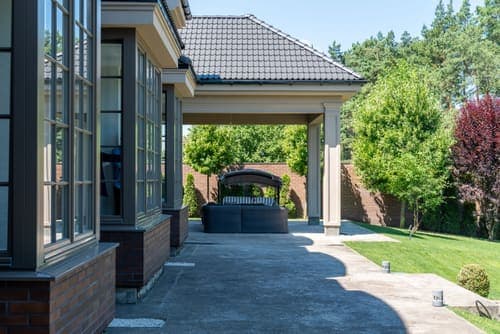
Stamped Concrete Patio
A stamped concrete patio is one pour and one shot, so the whole job lives inside a window of maybe half an hour when the slab is firm enough to hold a print and soft enough to take one. Push the mats in early and they sink and float mud over the pattern. Wait too long and you get a faint texture that wears flat off the traffic path in a few summers.
We tamp in sequence, keep the release powder even, and hand tool the perimeter and the seams where a mat can't sit flat, which is the fussy hour a lot of concrete patio installers skip.
Ashlar slate, wood plank, running bond brick. Pattern detail, the size of the slab, the color count and how far we're barrowing from the street all push the price around.
Stamping is a good share of our local concrete contractors service.
Paved Concrete Patios
Paved concrete patios are the plain-finish version: a flat slab, broom textured so it isn't slick when wet, joints cut straight, nothing stamped into the surface. We strip the loose stuff out, compact six inches of processed gravel, then pour four inches of concrete with fiber or mesh running through it. We pitch the slab away from the house too, a fall you'll never feel underfoot but a January thaw will find every time.
Pour concrete patio slabs onto soft ground and one corner drops inside two or three winters. Your table wobbles, water pools where you sit, and the fix costs more than doing it right did. Skipping the base is the oldest shortcut in the trade.
Size, how close the truck can get, and whether we're wheeling barrows around the side of the house move the price further than the finish ever will.
Painted Concrete Patio
A painted concrete patio is a film sitting on top of the slab, so what happens under that film decides how long it lasts. We grind or etch the surface open, fill the low spots, and make sure the concrete is dry before a drop of paint goes down.
Plenty of concrete patio companies will roll color straight over a dirty, glossy slab in an afternoon, and by the next humid stretch it's lifting in sheets and you're out there with a scraper.
Two coats of masonry acrylic, with sand broadcast into the top coat so the surface isn't an ice rink after a thunderstorm.
Size drives most of the cost, along with how much old coating has to come off and how rough the concrete patio slabs have gotten under it.
Staining Concrete Patio
Staining concrete patio slabs is coloring, not covering. Acid stain reacts with the lime in the slab and leaves a mottled, translucent finish, so two patios poured the same week can come out looking like cousins rather than twins. That's the appeal, and it's also the limit: stain won't hide a patch, a grease shadow under where the grill lives, or a spot where somebody burned the surface hard with a trowel.
So we strip the old sealer or paint, degrease, and etch lightly before any color goes down. Skip that step and you get blotches in all the wrong places. Once the color is in, we neutralize the acid and rinse until the water runs clear.
Size, the shape of the slab, how many concrete patio stain colors you want layered, and what has to come off before staining a patio starts are what change the number.
Sealed Concrete Patio
Sealing a concrete patio is the cheapest insurance on the whole slab, and nobody notices it until the surface starts flaking. We scrub it down, let it dry properly, then roll a thin coat of acrylic sealer and cross it with a second pass at right angles so you get no lap lines. Thin is the whole game.
Piled on heavy, sealer traps moisture underneath, blushes milky white and peels off in sheets by spring, and plenty of concrete patio companies pile it on because one fat coat is quicker than two light ones. What I won't do is seal a slab that's still damp below the surface, or one poured a few weeks ago that still needs to breathe.
Sealing will take a day, you can walk it that afternoon, and it gets redone every two to four years. Size, access and how filthy the surface has gotten are what change the cost.
Refinish Concrete Patio
If you want to refinish a concrete patio rather than break it out, we grind the top down to clean, sound material, vacuum the dust, then trowel on a cement based overlay with polymer in it. That covers the pitting, the tired old broom marks and the pale shadow where a planter sat for nine summers. Texture is yours to pick: smooth trowel, light broom, or a knockdown finish.
It's the call most concrete patio contractors get once a slab looks rough but is still flat and solid.
What I won't do is float an overlay over concrete that's still moving. If a section rocks under your boot, that's concrete patio repair first, because an overlay is a skin and it can't hold two halves together.
Size, how much grinding it takes, and whether an old coating has to come off are what shift the estimate. Most refinish work takes a day, and you can walk it that afternoon.
Concrete Patio Repair
Most concrete patio repair I do is one corner, one crack, or an edge that has gone crumbly while the rest of the slab is still perfectly sound. I saw the crack out first, clean the sides back to solid concrete so the patch has something to bite into, then fill and finish it flush. What I will not do is trowel a skim of mortar over a crack with a soft lip under it.
That lets go by the second winter and takes a chunk of good concrete with it. Spalled edges get cut square and re-formed. A heaved corner gets lifted or replaced, never shimmed with pavers.
Size, how deep the damage runs, whether we can get a mixer around the side of the house, and how late in the cold season you call all change what the repair involves.
Tinted Concrete Patio
A tinted concrete patio gets its color from pigment batched into the mix itself, so the shade runs through the full depth of the slab. Drag a chair leg across it and chip an edge, and what shows is color, not gray.
Where it goes sideways is matching. Two trucks poured a few days apart, or one load the driver splashed extra water into on your street, and you've got a patio in two tones forever. We order the whole pour on one batch ticket, keep the water tight, and cure it covered so it doesn't dry blotchy where the afternoon sun hits hardest.
Picking a shade off a chart is the easy part. Getting it out of the truck the same twice is the work, and that's what you're hiring concrete patio contractors for.
Deep charcoals and reds take more pigment than soft buffs, so the color you choose moves the price along with the square footage.
Epoxy Patio Colors
The epoxy patio colors we pour run from solid slate gray and warm tan through metallics that swirl under the clear coat, plus flake blends that hide pollen and paw prints better than anything else out there.
Outdoors, ultraviolet is what beats epoxy. Straight epoxy ambers on a south facing slab inside two summers, so the color coat is never the last coat. We diamond grind the concrete patio open first, test the slab for moisture pushing up from below, lay the color, then put a UV stable urethane over the top. Skip the grind and you'll be peeling sheets off after one winter of freeze and thaw, usually starting at a doorway or a step nose.
Slab size, how much patching it needs before we coat, and whether you want flake or metallic all push the price, since both add coats and cure days.
Concrete Patio Paint Colors
Concrete patio paint colors are really a question of how the color behaves in August, not how it looks on a chip under store lighting. Charcoal and deep navy look sharp on the sample and cook bare feet by two in the afternoon. Buff, tan and a soft slate gray stay walkable and hide the pollen that coats everything around here in May.
Deep reds and blues carry the pigments that fade first, so a painted concrete patio in those shades goes chalky on the sunny half while the part under the table stays rich.
Whatever color you land on, prep decides whether it lasts. We grind or etch the surface first, because paint rolled over hard steel troweled concrete peels in sheets by the second summer, and plenty of patio installers skip that step. Two coats, minimum.
Concrete Patio Stain Colors
Concrete patio stain colors are the thing people agonize over longest, and I understand why: stain soaks in and stays. The tans, brick reds, coffee browns and slate grays mostly come out of the same acid or water based families, but the same bottle reads darker on a broom finish than on a hard troweled one, because rough texture holds more pigment.
That's why we stain a test patch on your own slab, in your own afternoon light, before anything else gets color.
Where it goes sideways is expecting paint. Stain is translucent, so old patchwork, grease and hard water marks come through it, and the mottling some people call a flaw is the effect you're paying for. Two colors layered will soften a blotchy slab; one flat pass will announce every mark on it. Depth of color and how many passes you want moves the quote, and the test patch is the step other patio installers skip.
Concrete Edging Patio
A concrete edging patio is the band we pour around the outside of the slab, and it earns its keep two ways: it holds the lawn back and it gives the slab edge something to lean on instead of crumbling into the grass. We trench deeper than most people expect, tamp crushed stone in the bottom, and bend flexible form board around the curves so a radius comes out smooth rather than faceted like a stop sign.
What goes wrong is a shallow ribbon poured on bare dirt. Some concrete patio installers do exactly that, and one Springfield winter lifts it, cracks it at every thin spot, and now you've got a broken border to pull out before anything else gets fixed.
Length of the run, how many curves are in it, and whether we're wheeling every yard through a narrow gate change the work more than anything.
What the job involves
A concrete patio is mostly work you'll never see once it's finished. We strip the sod, dig down about ten inches, lay crushed stone in lifts and pack each one tight, then frame the shape and pour a four inch slab with fiber mesh running through it. Control joints get cut every eight to ten feet, because concrete cracks and the only real question is whether it cracks where we told it to.
We pitch the surface away from the house so snowmelt heads for the yard instead of your foundation, and a sealed concrete patio sheds the salt and freeze-thaw a lot better than a bare one.
Figure two to three days of work, then a week before the grill goes back on it. Size, dig depth, an old slab coming out, and whether the truck can reach the back are what move the price.
What it costs
What a concrete patio costs comes down to a handful of things, and square footage is only the first. A clean rectangle out back with a straight run for the truck pours cheaper than a wraparound behind a fenced yard where every wheelbarrow goes through a three foot gate. Depth moves it. So does what goes underneath: stone base, drainage, wire or fiber in the mix.
Borders and steps add hours, so a concrete edging patio detail is real labor, not a garnish. A tinted or sealed concrete patio finish sits above a plain broom finish. And if we're looking at concrete patio repair on tired concrete patio slabs, the condition decides it, because I can't price a crack I haven't put my boot next to. Call me at (413) 547-4797 and we'll measure it together.
Cold weather pours need blankets, which is why late season work runs heavier than a summer one.
When concrete patio is the wrong fix
A concrete patio is the wrong fix when the ground behind it won't sit still. If your yard drops off hard and the soil is creeping downhill, a slab poured against that grade will tip and crack inside a couple of seasons. What holds that hill is a concrete retaining wall, and the wall goes in first.
Same deal if you plan on parking there. Patio thickness over a patio base won't carry a truck. That's concrete paving, poured deeper on compacted stone, with the apron and curbs formed at the same time, and a slab behind a shop or a loading door is commercial concrete work.
And stamped concrete laid over a slab that's already lifting at the joints just buys you one nice summer. Plenty of concrete patio installers will pour anyway. I'd rather quote you the right job.
Why choose us for this
You want your concrete patio poured, or fixed, once. By one crew. And then you want to stop thinking about it for a good long while.
So here is what we will not do to you:
- Quote a number over the phone and hand you a bigger one on the invoice.
- Start your slab, then vanish onto somebody else's job for a week.
- Lean on you to sign today because the price supposedly expires tonight.
- Leave washout, rebar offcuts and broken concrete sitting on your grass.
We are not the lowest bid among the concrete patio companies you call, and that is on purpose. Base prep, compaction and control joints eat a day that nobody ever sees, and skipping it is why slabs crack in their second winter.
Size, truck access, and how far gone the old surface is are what move the number. Coming out to look costs you nothing and commits you to nothing.
Frequently asked questions
How soon can I use my new concrete patio?
Light foot traffic in about three days, patio furniture and the grill after a week. The slab keeps gaining strength for roughly 28 days, and that's when we come back to seal it. A sealed concrete patio put down in warm weather cures on schedule; pour it late in the fall and we watch overnight temperatures, because concrete that freezes in the first day or two loses strength at the surface and you see it flaking off the next spring.
Can my old patio be fixed, or does it all have to come out?
Depends on what moved, and there's a real line between the two. Hairline cracks, a bit of spalling in the top half inch, tired color: that's concrete patio repair or an overlay to refinish concrete patio surfaces, and it goes down in a day or two. But if the slabs have heaved, tipped toward the house, or the subgrade underneath has washed out, an overlay just rides along with the problem. Then we break it out and start with the base.
Will your crew tear up my yard getting back there?
Some, and I'd rather tell you now than surprise you. Wheelbarrows and a skid steer leave ruts in soft ground, so we lay plywood on the run and keep the mixer as close to the street as the truck can get. Tight backyards mean more hand carrying and a longer day. We rake out the ruts and put topsoil back along the concrete edging patio line before we leave.
How often does a stamped concrete patio need resealing?
Every two to three years here, sometimes sooner on the sunny south side. Our winters are hard on decorative work, and rock salt tracked off boots eats the surface faster than the freeze does. Sand and a plastic shovel instead, and the color stays put.
Contact The Springfield Concrete Company now
Ring (413) 547-4797 and we'll get you on the calendar. The concrete patio installers who come out and measure are the same ones who pour it, so when I'm standing on your grade looking at the downspouts, the fence gate and how close the truck can back in, I'm working out how we'd actually build it, not guessing for somebody else to figure out later.
Tell me what you've got back there. Bare dirt, or an old slab you'd rather refinish than break out? Prep for a tinted concrete patio isn't the prep for a painted one, and if you're staining a patio you already own, how that surface has weathered decides which concrete patio stain colors will take at all. I bring chips and epoxy patio colors so you can hold them against the siding in daylight.