Nobody in this city plans a new concrete driveway in July. It happens in March, when the frost has finished chewing on the old slab and you're steering around your own apron like it's the Big E parking lot on a rainy Saturday.
That's where we come in. The Springfield Concrete Company pours driveways from Forest Park to Sixteen Acres and out toward East Longmeadow, and we do the boring parts properly: dig to solid ground, compact the base, set control joints where the slab already wants to crack. Skip those and you get the mess you're currently parked on.
What I promise you is conduct. We show up when we said, we call back, we haul off our forms and cutoffs, and nobody talks down to you about rebar.
Below: how the pour goes, what moves the price, where we work, and the questions folks ask before booking. Ring (417) 464-6822 and I'll come look at it.
Driveway
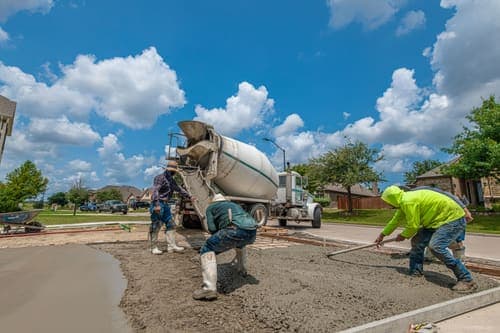
A concrete driveway here is only as good as what's buried under it, so that's where most of our week goes. We dig out eight to twelve inches, lay processed gravel, and compact it in lifts rather than one hopeful pass. Then four inches of 4,000 psi mix, five where the truck parks, with mesh or rebar sitting up on chairs in the middle of the slab instead of napping on the dirt.
Control joints get cut the same day or the next morning, roughly every ten feet. Concrete cracks. We'd just rather pick the spot.
A standard drive in Sixteen Acres or East Forest Park runs about three days of work, then you stay off it a week and keep the heavy stuff off for 28 days. Square footage, demo, and slope are what move the price on any pour we do as The Springfield Concrete Company.
Driveway Sealing
Driveway sealing is the cheap hour that buys you years, and on a concrete driveway what we're rolling out is a penetrating silane or siloxane sealer, not the glossy acrylic that goes milky white after one Springfield winter. On a fresh pour we wait the full 28 days before the first coat. After that, every two or three years, sooner if your slab catches plow spray and rock salt off the street.
We pressure wash, let it dry a solid 24 to 48 hours, then apply two thin coats. Sealing over open cracks just seals water in, so cracked driveway repair comes first, no exceptions. And we won't seal in late November when nights drop below 50 degrees, because it won't cure, it'll just sit there sulking.
Square footage and how much prep work it needs are what move the number.
Driveway Fix
Not every concrete driveway needs tearing out. A driveway fix is often just one bad panel: we saw cut the joint lines, break out that section, re grade and compact the base underneath, and pour back at four inches with fiber in the mix. One day of work, then stay off it a week before you park on it.
The other common one is a settled slab by the apron, where water now runs toward your garage instead of the street. We can lift that rather than replace it if the concrete itself is still sound.
What moves the price is how many panels, how much base has washed out, and whether a truck can get close.
Salt from the winter plows chews the top layer, and at The Springfield Concrete Company we grind and resurface that before it goes deeper than a quarter inch.
Sealing Cement Driveway
Sealing a cement driveway is the smallest job we do and the one that saves you the most grief later, because sealer is what keeps road salt and February's freeze and thaw cycles out of the pores. A fresh pour waits about 28 days before its first coat. After that, plan on every two to three years, sooner on a slab that takes plow scrape and a winter's worth of salt off the street.
Here's how we run it. Power wash, let it dry a full day or two, handle any cracked driveway repair first since sealer bridges a hairline and nothing wider, then two thin coats of penetrating silane siloxane at 50 degrees and rising.
Thick acrylic slapped on a damp slab is the classic mistake. It goes milky white and peels off in sheets, and at The Springfield Concrete Company we'd rather strip nothing.
Paver Driveway Installation
Paver driveway installation is a different animal from pouring a slab, and the whole thing lives or dies in what you can't see. We dig out ten to twelve inches, lay process stone in four inch lifts, and compact every lift before the next one goes down. Then an inch of screeded bedding sand, pavers set and cut, edge restraint spiked every foot or so, and polymeric sand swept in and vibrated twice.
Skip that edge restraint and by the third Springfield winter your border pavers are wandering off into the lawn like they've got somewhere better to be. Too much bedding sand and you get tire ruts by spring.
A standard two-car job takes us three to five days, weather and cuts depending. The crew at The Springfield Concrete Company sets the pitch while the base is still open, because that's the only easy time to do it.
Drainage In Driveway
Drainage in a driveway is the part nobody thinks about until February, when the sheet of ice in front of the garage door starts deciding where you park. We pitch the slab at least a quarter inch per foot away from the house, and on the grades around Forest Park and Sixteen Acres that alone doesn't always cut it, so we'll set a channel drain across the apron and run it out to daylight or a dry well.
Water that sits under a concrete driveway freezes, lifts, and cracks the slab from underneath. You can patch the top all you like, it won't fix a grade problem.
What moves the number is trench length, how far the discharge has to travel, and whether your downspouts are emptying onto the pad. At The Springfield Concrete Company, we sort the water before we pour.
Driveway Installers
Driveway installers all sound the same on the phone. The difference shows up in the two hours before any concrete arrives. My crew at The Springfield Concrete Company strips the topsoil out, brings in six inches of processed gravel, and compacts it in lifts with a plate. Skip that and the frost gets under your slab by February and lifts it like a bad card trick.
Then forms, rebar or mesh up on chairs, a 4,000 psi mix poured four inches thick, five at the apron where the delivery trucks cut the corner. We saw control joints inside the first day so the concrete cracks where we told it to, not where it feels like it.
A standard concrete driveway in Sixteen Acres runs two days of prep and pour, then seven before you park on it.
Cracked Driveway Repair
Cracked driveway repair is worth doing when the slab is still sitting flat and the cracks are cosmetic, which around here means hairlines and anything you could lose a dime in. We chase the crack open with a diamond blade, blow it clean, drop in backer rod where it's deep, and fill with a self-leveling polyurethane that flexes through the freeze-thaw swings that show up every February. Silicone caulk from the hardware store peels off by the next salt season. Most repairs on a two-car concrete driveway are a morning's work, and you're driving on it that evening.
The part nobody likes hearing: if one side of the crack has dropped, the base underneath washed out, and filling the gap just makes a straighter line. That's when The Springfield Concrete Company talks to you about a saw-cut and a new panel instead.
Crushed Cement Driveway
A crushed cement driveway, sometimes called recycled concrete, is old broken slab run through a crusher and laid back down as base stone, and it's a solid answer for a long rural drive out toward Wilbraham or Hampden where a full concrete driveway would cost more than the barn it leads to. We spread it in two lifts, compact each one, and crown the middle so water runs off instead of standing. Skip the compaction and you get ruts by March, right when the frost comes out and everything turns to soup.
Two things kill it: no edging, so the stone migrates into your lawn, and a plow blade set flat, which peels the surface off every winter. We'll grade and top-dress it as needed, and if you later want the real thing, The Springfield Concrete Company pours over the same base we already built.
Milling Driveway
Milling a driveway means grinding the old surface off instead of burying it under a fresh one. We run the machine an inch and a half to two inches down, sweep the base clean, and haul the millings out. That matters most at the garage apron, where one more layer leaves you a lip the door can't close over and water sitting against the sill.
Skip the milling and the drive ends up sitting proud of the walkway, shedding meltwater back toward the house, and cracking along the seam by the second Springfield winter.
On a driveway replacement where you're going from blacktop to concrete, we mill, then regrade and compact before any concrete driveway installation begins. Asphalt driveway companies mill to repave. At The Springfield Concrete Company, we mill so the slab underneath us starts flat and honest.
Asphalt Driveway Companies
Plenty of folks in Springfield call the asphalt driveway companies first, get a number, then call us to see what concrete looks like next to it. Fair enough. Blacktop goes down in a day and you're parking on it by the weekend. Concrete makes you wait about seven days before the car goes on, twenty-eight before anything heavy does. What that patience buys you is a slab that won't soften and rut in an August heat wave, won't scar where you turn the wheel, and won't want a fresh coat every couple of years.
Asphalt driveway paving companies do good work on the right job, long rural runs especially. But on a short city drive off Sumner Avenue, the freeze-thaw eats the edges. At The Springfield Concrete Company we build the base first, because that's what actually fails.
Driveway Replacement
Driveway replacement is what I recommend when the slab has stopped being one slab and started being a puzzle: settled panels, spalled surface, cracks you can lose a tape measure in. Patching that is putting a bandage on a broken leg. We break out the old concrete, haul it off, then dig down and compact a proper process gravel base, because most failures in this city trace back to skipped compaction, not bad concrete. Then four inches for cars, five or six if you park a work truck, air entrained mix so our freeze thaw winters don't chew the surface, and control joints cut the next day.
Demo through pour usually runs two to four days. Stay off it a week, and hold off on sealing about a month.
What moves a concrete driveway installation price here is access, how much old material comes out, and whether the grade needs rebuilding. That is the same math The Springfield Concrete Company uses on every replacement we quote.
What the job involves
A Springfield concrete driveway is mostly work you never see. We break out the old slab and haul it off, dig down eight to twelve inches, and compact a process gravel base in lifts. A driveway that sinks in Sixteen Acres started sinking before the mixer ever pulled up. Then forms, rebar or wire mesh, and a four inch pour, five inches where you park a truck or a trailer.
We use an air entrained mix, which matters when February gives you 42 degrees at noon and 18 by midnight.
Control joints get saw cut within a day, not scratched in with a trowel. Skip that and the slab picks its own cracks, and it has terrible taste. Give it a week before driving on it, and no rock salt that first winter. That's every concrete driveway installation we do at The Springfield Concrete Company.
What it costs
The concrete driveway cost on your place starts with square footage, but what really moves it is everything you can't see once the truck leaves. Tear-out and hauling of the old slab. How deep we dig for processed gravel, and whether the subgrade is decent or the kind of clay that holds water all through a Springfield March. Four inches of slab versus five or six if you park a work truck on it. Fiber mesh or rebar, apron and curb cut work, broom finish versus something stamped. Skip the base to shave the number and you'll be reading cracks by the second thaw, which is the expensive way to save money. Call The Springfield Concrete Company at (417) 464-6822 and we'll measure your driveway and give you a real figure, not a guess off a satellite photo.
Why choose us for this
You want a concrete driveway you can pour once, park on, and stop thinking about while the frost comes and goes off Sumner Ave every February. Not a project you have to supervise.
So here's what we won't do to you.
No number that grows on the invoice: The figure I give you after I've walked the slab is the figure you sign, unless we open the ground and find something neither of us knew about, and then you hear it from me before we pour.
No Irish goodbye: We don't start your pour and then disappear onto a second job across town. We finish, we clean up, we haul the broken slab out.
No signing today: Sit on it a week. The estimate costs you nothing either way.
We're not the cheapest bid you'll get, and that's deliberate. The Springfield Concrete Company crews spend a full day on base prep other outfits skip in an hour.
Frequently asked questions
Will pouring a new concrete driveway tear up my lawn?
Some of it, yes, and I'd rather tell you now than on the day. A loaded mixer is around 60,000 pounds, so wherever it rolls, the grass gives up. We run plywood or mats over the approach, keep the truck on the street when the chute reaches, and rake and reseed the shoulder when we're done. If your town sidewalk or apron sits in the way, we saw a clean joint and put it back rather than leaving a patched mess at the curb.
What's the difference between resurfacing and replacing?
Resurfacing puts a thin overlay on top of a slab that's still sound. You can refinish concrete driveways that have surface scaling from road salt and plow blades, but if the panels have settled, rocked, or opened up cracks you can drop a nickel into, an overlay just mirrors those cracks back at you inside a winter or two. That's when we talk about replacement instead: full tear-out, compacted base, and 4 inches of new concrete, or 5 to 6 where a work truck parks.
How many days am I without it?
Usually four to seven days from the first shovel. Demo and base prep take a day, forms and pour another, then you stay off the surface entirely for 24 to 48 hours, drive a car on it after seven days, and wait 28 for anything heavy. We pour April through November here; below 40 degrees we blanket it or we wait.
How do we get started?
Call The Springfield Concrete Company at (417) 464-6822 and we'll come measure, look at your drainage, and walk the job with you.